Showing posts with label adults. Show all posts

Tuesday, December 6, 2016

Not just a flash in the pan: Vengeance Road, Erin Bowman

Vengeance Road
Erin Bowman
HMH Books for Young Readers, 2015
978-0544466388


You guys. It’s well documented by now that I’m a sucker for a cross-dressing, historically fiction-y, adventure with a twist of romance squeezed over the top novel. I’m looking at you, Bloody Jack, Song of the Lioness Quartet, and most recently, Gold Seer books (I read the second one; it was an awesome albeit at time crushing finale - read it!). The later is totally appropriate to end that aside with, because there’s a bit of a Western element to it, which ties nicely to this one, the truly, madly, deeply, Western you never knew you were missing.

Monday, July 6, 2015

Do Not Say Knope Thank You to Yes Please


Yes, yes, I know it has been forevermanytrillion moons (that’s a real measure of time, I’ll have you know) since I last wrote some reviews.  Shame. Or not so much.  I’ve been busy, like, doing other librarian things like being a first year director, commuting, being lazy, whining about snow, being lazy, and eating, lazily.  As you can see, my dance card has been set to busy.  But one of my many goals this summer is to tell you all what you should read like my bossy spirit animals command you to (The Notorious RBG, Tami Taylor, Mrs. President, Missy Elliot, the real Mrs. President, etc.)  With no further adieu, yes, please, pull up a slice of couch and let me tell you all about a book I just finished reading roughly ten minutes ago, written by another of my favorite bossy lady spirit animals, Amy Poehler:

Monday, April 28, 2014

Half Bad, by Sally Green: Wholly Good


Half Bad
Sally Green
Viking: New York, 2014.
ISBN: 978-0670016785
ARC provided by publisher on NetGalley

Imagine a young British man with magical powers.  He is unique, monitored by his government for it, parentless, and disliked by most members of his family.  His name?  It's not Harry.  In this magical title, the grit is grittier, the dark darker, and the protagonist less of a crowd pleaser than in a certain other series about a young wizard.  Nathan a half code - the only person to have Black and White witch parentage.  He is consequently constantly monitored and tracked by the powerful White witches, whose ministry places ever tightening restrictions upon half codes.  In this England, White witches fear and hunt all Black witches.  Nathan's White witch mother is dead, and his at-large father is the most powerful Black witch alive.  As the edicts become more and more austere, Nathan is placed in a cage somewhere in the Welsh wilderness, and his family and the girl he loves - a forbidden White witch - punished for associating with him.  This gripping first in Green's new series is a start to finish, high stakes adrenaline rush, where good and evil aren't just that.  Thought it will appeal to fans of a certain other English wizard, it is much more gritty, crass, and violent, and is recommended to older teens and adults.  

Any more words seem unnecessary, and will slow you down in your quest to acquire and commence your magical reading experience.  It is one of the books I've most enjoyed reading in 2014.  You will not be able to put this one down.  Get at it, yesterday, team.

Thursday, October 3, 2013

Eleanor and Park, by Rainbow Rowell: Wear your heart on a mix tape (and hope it doesn't get banned, punks)

Eleanor and Park
Rainbow Rowell
St. Martin’s Griffin: New York, 2013
ISBN: 9781250012579

Eleanor and Park are two 16-year-olds living in Nebraska.  They couldn’t be more different: he comes from a middle-class family, has the right clothes, music, and a good family.  Eleanor doesn’t.  She shares a room with four younger siblings, her mom is on a second marriage to an abusive, alcoholic stepfather, and there’s never enough to go around.  Eleanor is roundish and has red hair.  Park is short, and Korean-American.  She is bullied, he is not, but when they sit next to each other on the bus, slowly, very slowly, a deep and true affection begins to develop.  This achingly realistic novel of first love is as authentic as it is simple.  It stunningly redefines what romance means for the YA market, and is strongly recommended to anyone who has a heart (aged 15 and up).  

I’m not kidding.  This. Book.  GAWD.  It was on my radar for many, MANY moons, my amigas kept telling me to read it, the Internet went crazy for it...it took me forever, but I’m very glad I finally did.  It is so profound, yet so quiet and unassuming.  It is simple.  Yet it is...brilliant.  It is incredibly moving yet not extraordinary, which makes it so, and I hope to see more books like this, and way less sensationalism and love triangles from now on in YA because of it!  I want to just throw a bunch of adjectives at you to describe it, like heartbreaking, breathtaking, delicate, moving...just trust me and read it, already - both boys and girls of all mature(r) ages reading this!  Here are a few of the details I’d like to debrief:

Friday, August 2, 2013

Dinner Train: The Raven Boy

The Raven Boys meets The Raven Boy
Once upon a time, long ago and far away, I lived in a castle atop a hill with several other beautiful princesses, a fire-breathing dragon, and our loyal manservant, Maurice.  That’s only sort of true: it was sixish years ago, we lived on a cliff in the top two floors of a run-down Victorian house, the fire-breathing dragon was an oven that shot fireballs out when you turned it on, and our manservant was neither loyal nor male, but rather a birthday cake stealing, pregnant racoon named Maurice.  

The one truth?  There were in fact beautiful princesses (and more as the years went on), and we had a magical fresh out of college experience, navigating the perils of the new adult world (running out of French Onion Dip, Brazilian DJs showing up to your housewarming parties, a bathroom without a door, and a landlord who once tried to fix a broken door using only a snow shovel) way more classily (sometimes), and well fed than the girls seem to do on Girls.  More importantly, a group love of YA/fun literature swept through the ranks in the house - we did group reads for things like Breaking Dawn, hazed new roommates with gifts of Outlander, made mixes for books...you get the idea. This appropriately titled blog started right back about then!


Pretty pretty princesses.
It seemed only fitting that in a year when three members of the first generation of the house would be turning 30, and another is having her first baby, that said first generation (and moi, generation 1.5) should muster and eat way too much cheese, drink some wine, and reflect upon these momentous life events.  Naturally, we decided to have a faux book club in anticipation of this event, and even more naturally, choose a YA book about a group of magical friends: The Raven Boys.  JUST LIKE US.  I reviewed it last year, but was really glad to reread it and discuss with like-minded BFFs, especially in light of the sequel (one of...several? I’m unclear what “cycle” means, publishing world.), The Dream Thieves, dropping in just about a month.  Maybe I have a copy.  Maybe you should stay tuned for that review...

A pizza feast fit for Welsh kings,
Raven Boys, psychics?

We’re a little older and theoretically wiser now (which is just a polite way to say that we don’t bounce back like 22-year-olds anymore; our drinks better be worth it!).  We’ve certainly become way better and more confident chefs, even when faced with the daunting challenge of making pizza (in honor of Blue’s job as a pizza parlour waitress, and meeting the Monmouth boys for the first time at work) in a 1970s kitchen lacking any baking sheets.  Over several rounds of Marry Shag Cliff (Does anyone keep Noah?  Poor guy.) and group casting as characters in the book (apparently I’m Maura? Whattt? Disagree?), a feast fit for Glendower was prepared.  I whipped up a little something I’m calling the Raven Boy to toast both our reunion, and the Raven Boys with.  It’s got a little bit of everything from the book in there: mint for Gansey, Bourbon for the Southern Henrietta accents (also alcohol, for Ronan), black-blue for both Blue and the Raven boys, and is served ice cold.  Like Noah! 

Making magic happen in old kitchens since 2005.
This is our kind of tea reading.
Recipe below - but do note that you can use the syrup with more seltzer to make a non-alcoholic version of this, any teens who may stumble across this recipe.  

The Raven Boy
(Blackberry Lime Julep)

The Raven Boy, inspired by Maggie Stiefvater's The Raven Boys

Wednesday, June 19, 2013

Gone Girl, by Gillian Flynn: Sometimes books for grown ups happen, even to the best of us

Gone Girl
Gillian Flynn

Crown: New York, 2012
ISBN: 978-0297859383


By all accounts, Amy and Nick Dunn are the perfect couple, from looks on down to their marriage.  When the recession leaves both of them unemployed, they move from New York to Nick's suburban Missouri hometown to care for his terminally ill mother.  Using the remainder of Amy's trust fund, Nick opens a bar and they settle into a life very different from their urban one, until Amy disappears with signs of a struggle on the fifth anniversary.  Nick and the police are left bewildered, with few leads.  All is not as it seems in this contemporary noir though things are starting to point to Nick.  Told in alternating chapters between Amy's diary recalling their past, and Nick's narrative voice in the present, this novel is suspenseful and engaging.  It is easy to see why this became such a bestseller, and it is recommended for adults and mature teens aged 16 and up, for sexuality and violence (and sheer plot complexity).  

Sunday, April 7, 2013

Quintana of Charyn, by Melina Marchetta: Can't we all just get along? Call me, maybe?

Quintana of Charyn (The Lumatere Chronicles)
Melina Marchetta
Candlewick: Somerville, 2013. 
ISBN: 9780763658359 (ARC reviewed)
Available in the USA/Canada April 23, 2013. 


When last we left them, the titular characters in Melina Marchetta’s Chronicles of Lumatere trilogy had left their readers on the edge of a gravina (aka a cliff). Not literally – it was just the bestworst kind of cliffhanger.  What a way to leave the readers hanging, with our two favorite nations, Charyn and Lumatere, on the verge of letting misunderstanding and deep-seeded grudges steer them in a course of hasty war!   We pick up where we left off, and though the action thankfully shifts, there are several dozen pages of will or won’t they agony, coupled with the fear of the survival of both Froi and Quintana.  All these important questions, plus some you didn’t even realize you had, are summed up in Marchetta’s presumptive finale to the series.  Characters travel great distances, searching for answers and for each other, and prejudices and fears must be tested and unlearned.  Politics, family, forgiveness, and love are the powerful and pensive themes in this title.  Though the course is agonizing, and to go into detail would be to spoil SO many of the myraid plot points, Quintana of Charyn is a deeply satisfying read.  Deep breathing technique practice is optional, yet encouraged.  It is a strongly recommended book for older teens and adult readers, and for all libraries with a vested interest in smart, well-crafted fantasy.  If you own the first two and are reconsidering, what are you, monsters?  

Friday, September 21, 2012

Rollrock Island, by Margo Lanagan: Your momma's a seaweed lovin seal!

The Brides of Rollrock Island
by Margo Lanagan
Alfred Knopf BFYR, 2012
ISBN: 9780375869198


“Seals do not sit about and tell, the way people do, and their lives are not eventful in the way that peoples are, lines of story combed out again and again, in the hope that they will yield more sense with every stroke.” (p. 255).  Old Celtic fables tell of Selkies - seals who shed their skins and walk on land as people.  On Rollrock Island, the tales are part of island life.  Miskaella, a young girl, realizes there is truth behind the legends when she wakes one day with the power to lure seals from the sea, and eventually even the ability to call the bewitching selkies from their seal-skins.  Cruelly treated and branded a witch for her abilities by other villagers, Miskaella grows frustrated and contemptous from their mistreatment, vowing her revenge.  One by one, the men of Rollrock abandon the island women in favor of the mysterious seal-women Miskaella calls forth from the sea, paying her dearly for it.  The human female population of Rollrock abandons the island for the mainland, leaving it to the men, boys, and Selkie women, who long, silently to return to the ocean.  The sons of these women are not immune to this sadness in their mothers; they hatch a plan to return the skins to their mothers, who weave sea-skins of their own to bring their sons with them when they return to the sea.  This is a richly wrought and haunting tale, with beautiful descriptive language.  Though marketed as YA, it will find more success with adult readers who won’t be deterred by the alternating perspectives, sense that questions are left unanswered, and the serious tone.  

Hello, you had me at selkie.  No, seriously.  That’s why I requested and then raced through this one.  Plus, it sounds slightly more exciting in the publisher press then it actually is - it’s rather more of a slow paced, methodically haunting tale.  In a way, I really liked this.  In another way, I really was less satisfied with it when I finished it than I had been while reading it, if that makes any sense at all.  I loved the selkies and the myth-made-real nature of this story...but it didn’t entirely add up, for me (the story does wrap itself up, and hopefully).  I wanted to know if Miskaella was actually content, or why none of the Selkie mom’s tried to figure out where their seal-skins were, or...just more.  I think it would have helped to have one pov from one of the selkies, since we seemed to hear from a representative of every other faction (Miskaella, dudes paying her to get them a sea-order bride, the scored non-sea order brides, the kids,  etc.).  Again, I do believe that this is a book with far more adult appeal than teen appeal - I just plain think adults will connect with it better.  I’m not even sure what, if anything, makes it fall into the YA family.  There are as many, if not more, adult voices than teen/youth voices.  Does ….anticipate that more adult readers will just buy it if it is marketed as YA, since adults are buying more YA?  If so, good call.  Anyways, you can read this book if you like Celtic mythology, but then again, if time is an issue, just watch The Secret of Roan Innish.  And then let’s all go have a whiskey and talk about whether or not a grown lady could actual fit inside a seal skin.  My vote: no. Also, fish breath.  

Sunday, September 16, 2012

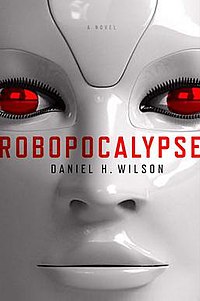
Robopocalypse, by Daniel H. Wilson: We're onto you, robots

Robopocalypse
by Daniel H. Wilson
Knopf Doubleday Publishing Group, 2011
ISBN: 9780385533867
Adobe EPUB copy from the Boston Public Library

Think, for a moment, about the number of times in a day you rely upon a machine.  We want our technology to do things we don't - to do the hings that we deem too tedious, too complex, too dangerous.  But what happens when the artificial intelligence we have harnessed to do this things gets too intelligent and figures this out?  In this recycled post-robot apocalypse thriller, the machines we rely on have rebelled against humans.  They are controlled and connected by a remotely located significantly intelligent artificial being, Archos, who views the human-robot relationship as akin to master-slave, and who wants to shift the balance.  In one fell swoop, robots control everything, from our dishwashers, to our cars, to our defense systems, and humans are either exterminated or sent to work camps.  Told in vignettes, Archos has watched and recorded the humans and machines who survive the initial apocalypse and lead the fight to successfully regain power.  Characters, both human and robot, are engaging, compelling narrators of their own stories in this rapid-fire, high-stakes, battle of the intelligences Sci-Fi.  Though published for adults, it will have strong appeal for older teens, and may even be an easy sell for reluctant male readers.  

Unless you live deep in the woods/dessert and are a technology eschewing hermit (which means you're probably not reading this), this concept (robots start thinking for themselves, overthrow the world) is not a new one.  Presumably, you've heard of the Terminator?  If you live in California, there's no excuse - you elected a robot governor! Some cooler kids may have even heard of Battlestar Galactica.  This story, however, while not new, is a fast-paced, exciting read.  It is also one with a global scope, taking place around the world, with a multicultural human (and robot) cast.  The writing is more servicible than fancy, but it keeps the pages turning and the readers hooked.  Stan, the YA lovin' PopStar of a friend, sent me a strong recommendation for this one; he correctly thought my male students would dig it.  He was right!  They will!  It is such an easy sell to reluctant reader boys, along with the rest of us who may be less reluctant or are not boys.  My only warning?  Good luck thinking your appliances aren't out to kill you.  I see your glowing red eye, toaster!

Monday, February 13, 2012

El Narco: Inside Mexico's Criminal Insurgency, by Ioan Grillo: Nonfiction? No mames, wey!


El Narco: Inside Mexico's Criminal Insurgency by Ioan Grillo
Bloomsbury Press: New York, 2011.
ISBN: 968-1-60819211-3
Gringos, we’ve got a situation.  As in, our nearest neighbor that is not Canada is kind of in a big, big, world of mess right now.  And unfortunately, it’s partially our fault.  Mexico currently has an increasingly violent drug trafficking underground, which is frankly not getting any better.  I’ve never reviewed nonfiction before, but thought this would be an excellent foray into the field.  Why?  It’s timely, it’s more pressing than I think we Northerners realize (at least those of us further afield from the Mexican border), and I bought it because I work in a high school.  While I’d like to think my students are saintly, I went to high school too, and know that’s not the case, so I’d at least like to have something on the shelves to educate them about the bigger picture.  Ioan Grillo’s El Narco: Inside Mexico’s Criminal Insurgency is all of those things: timely, educational, thoughtful, and well crafted.  He covers the problem from all angles, looking at the history of the drug trade in Latin America, Mexican politics, the growth and evolution of regional trafficking gangs from small time farmer yahoo’s to big time militaristic and murderous operations, to potential solutions. 
El Narco isn’t just one gang; rather it’s a whole industry, and it has thrived and survived despite many efforts to the contrary.  I learned a lot in reading this book; for example, the USA won’t admit it, but SOMEONE was large scale supplying the US military with opiates to use a painkillers during World War 2, and that produced in Mexico and shipped north didn’t just disappear at the border… Nor was I aware that there is a whole film AND music industry pumping out Narco inspired songs and films.  While I knew about the increasing street violence, fear in the civilian population, and loss of faith by the Mexican people in their government’s ability to protect them, I was somehow less aware of the many rival factions and the scale at which they’ve become militarized. Frankly, it’s a little terrifying, especially when you factor in that these groups are now diversifying, expanding (Guatemala and Honduras are seeing an rise of the presence of these groups) and demanding tithes not just from small businesses, but  also from whole industries (oil, mining, etc.). 
Between the testimonies of former and current gang members, Mexican and United States officials, and civilians, this book presents a humanistic portrait of an often-barbaric industry.  It is compelling and frankly hard to put down (I don’t recommend reading it before bed…). I can’t stop thinking about it, and while I don’t think it will ever happen, I think Grillo makes a fairly compelling argument that legalizing the industry cuts their legs right out from under them and has been shown to eradicate violence.  Either way, it is a very thorough, readable, and thoughtfully informative look at a very timely issue.  This is a strong recommendation for all high school  and public libraries, and for older high school and adult readers. 
My one caveat?  There's no shame in admitting probably my favorite thing about nonfiction books are the illustration pages in the middle.  The pictures selected here are okay, but I couldn’t help but want to see pictures of some of the notorious drug lords, or the people that are interviewed, or...just a few more of everything!  Por ejemplo, I loved the images in a recent piece Damien Cave did for the New York Times about property in Mexico that belonged tobusted narcotraficantes, many of whom were mentioned in this book.  It’s truly haunting.  As is the second thing that comes up when you google el Narco; a blog in opposition to el Narco that tracks what's going on (you need to speak Spanish though, sorry).  In short, this is an issue that I now want to know more about.  Mission accomplished, Ioan Grillo!

Wednesday, February 8, 2012

Froi of the Exiles, by Melina Marchetta: Charyn't you glad it's got no froibles?


Froi of the Exiles, 
by Melina Marchetta
ARC from Candlewick, available 3/13/12

Three years have passed since Finnikin and Isaboe ended the Lumateran curse and exile and began rebuilding their country.  Now nearly 18, Froi has spent these years helping rebuild Lumatere and training with the Queen’s guard, both to mind his temper and to train to fulfill his promise to protect his queen.   Foreign relations are tense due to the long suspected role of Charyn in the Lumateran exile; to complicate matters, Charyn refugees are flooding the Lumateran valley on their border.  Fluent in Charnyite, Froi is given a secret mission infiltrate the desert country, impersonate a noble, and assassinate their king.  However, not even the trainings of the Guard could prepare him for what he discovers in the treacherous Charyn royal court.  Charyn has a curse of its own: no children have been born or even conceived in 18 years.  Charyn’s insane princess, Quintana, claims to be the only one to be able to break the curse.  However, Froi is strangely drawn to Quintana, who has become a victim of the curse, and to the Charnynite people, hesitating in his mission as his resolve to protect her and help Charyn find peace strengthens.  This wholly engrossing and beautifully constructed novel is filled with intrigue, dark humor, mystery, adventure, engaging new characters, and visits with old Lumateran friends.  More political thriller than pure fantasy, due to plot complexity and some sexual violence it is recommended to high school students and adults.   As a reader caveat, this novel ends on an excruciating cliffhanger! 

Hold your breath (or don’t is probably a wiser idea), because here comes a loooong review: 

Monday, October 3, 2011

The Future of Us, by Jay Asher and Carolyn Mackler: AIM for memory lane!

The Future of Us
by Jay Asher and Carolyn Mackler
Razorbill: New York
ARC reviewed, pub date November 21, 2011

It's 1996, the internet was accessed through the phone line, few people had computers, Jerry Maguire showed us the money, band camp hadn't yet been slandered, and Facebook wasn't even a wink in Mark Zuckerburg's prepubescent eye.  Life-long best friends and neighbors Josh and Emma have been a bit on the outs since Josh let his burgeoning feelings for Emma be known.  Emma's recently remarried dad has gifted her a computer. Josh's mom makes him bring over their AOL CD to install on her computer.  When she does, it loads to a site she's never heard of, something called Facebook, where an woman in her early thirties bears a striking resemblance to her, in addition to sharing her first name.  Even weirder, Josh has an older doppelganger with the same name too.  But every time they reload the page, things seem to change in the lives of these strange same faced and named people.  As they explore the site, Josh and Emma learn more about themselves and realize that the decisions they make change the lives of the people they will become.  This fun book may be best suited to older YA's, and especially towards twenty to thirty somethings who will nostalgically remember well the days when it took forever to log in to AOL...  

Friday, May 27, 2011

No and Me, by Delphine de Vigan: Sacre bleu my mind with a translation done right!

No and MeNo and Me
by Delphine de Vigan  (Translated by George Miller)
New York: Bloomsbury, 2010

 ISBN: 978-1-59990-479-5

 Precocious and bright Parisian thirteen-year old Lou is both intelligent enough to have skipped several grades and to realize that she is less mature than her older classmates.   Scientifically minded but shy, Lou panics when forced to publicly announce her plans for a class presentation and announces she will be interviewing a homeless woman, though she knows no homeless people.   Lou takes to the task like one of her scientific product tests, and soon has found her subject: No, a homeless young woman she meets at the train station.   No, and the interviews with her, open Lou's eyes to the heartbreaking world of the homeless that is hidden in plain sight as she comes to realize, visible only to those who choose to see it.   Having suffered a family loss, Lou's mother has been recovering from a deep depression for years, leaving just her often busy father to care for her, thus opening the door for naive Lou to throw herself into what becomes a near scientific obsession with trying to save No, going so far as to convince her parents to let No move in and get back on her feet.  As one may suspect, things don't go exactly as planned, but while there are some hard lessons learned and Lou's childish naivete is shattered, this gorgeously translated, thoughtful, and carefully constructed novel does not fall into cliches and is a testament in many ways to the qualities of hope, perseverance, and unflinching love.  It is strongly recommended for all collections, teens mature enough to understand the complexity of the issues (grades 8-12) and would be an easy sell to many adults as well.  

Remember when I went on and on about how I thought the translation of The Invisible was...okay?  Well, THIS, my friends, is a translation done right.  The language is gorgeous and moving, almost melodic.  As a former language major, I can assure and reassure you that translating words is easy - translating the feelings and emotions behind them and maintaining the original beauty is a tremendously difficult thing to do.   Behold:
 Sometimes I leave her there, in front of an empty beer glass.  I get up, sit down again, hang around, try to find something to comfort her.  I can't find the words.  I don't manage to go.  She looks down and says nothing.
And our silence is filled with all the world's impotence.  Our silence is like the return to the origin of things, their true state. (51)
I mean, DAY-YUM, shiver me timbers.  That's some weighty prose for a book marketed to kids.  That's not even the best of it; I'm just too lazy to search for more.  Mad snaps for George Miller, who has made me want to learn French just to read this in the original too!  But regardless, this book is wonderful because it takes what could turn into a totally cliched everyone's-feeling-sadface story (homelessness, depression, awkward teenage years, feelings of abandonment all around) and doesn't do exactly what you would expect with it in all cases.  Yes, it is not a "we saved a homeless girl, high fives all around" happy ending.  Unless you are possibly a teenager reading this, you realize there is more going on with why No is homeless than just that she has no home and nobody to care for her.  It's easy enough to spot how Lou is both scientifically obsessed with finding a cure for homelessness, starting with Lou, and how No is also filling an emotional void in Lou's life, left when her infant sister passed away and her mother disappeared into a very serious and long lasting depression.  Part of growing up, though, is realizing that not everyone wants to or can be rescued; as de Vigan says "things are always more complicated than they seem," (72).  Despite the potential to tie this story up with a shiny ribbon (and Lordy, Lordy, do I like things tied up), I found the "there is no one solution to this problem" ending quite satisfying, even refreshing because it recognizes that there is no one simple solution to a huge societal problem, but that it is one that we cannot ignore.  Perhaps my favorite passage in the whole book sums this one up, one which both foreshadows what Lou already may know in her heart and yet doesn't realize due to her youth:
Dogs can get taken in, but the homeless can't.  I thought to myself that if everyone took in a homeless person, if everyone decided to look after just one person,  to help him and be with him, perhaps there'd be fewer of them in the streets.  My father told me that wouldn't work.  Things are always more complicated than they seem.  Things are what they are, and there are lots of things you can't do anything about.  You probably have to accept that if you want to become an adult.  We can send supersonic planes and rockets into space, and identify a criminal from a hair or a tiny flake of skin, and grow a tomato we can keep in the fridge for three weeks without getting a wrinkle, and store millions of pieces of information on a tiny chip.  Yet we're capable of letting people die in the street. (71-72)
Double DAY-YUM.  Doesn't the optimism and teenage idealism just shank you right in the heart?  Don't you want the solution to be so simple?  And when you put it in those terms, it really is bananas that there is no solution, until, as Lou points out (and learns), you realize as an adult (or really with-it teen) that there are more factors in play than just the obvious problem.  This book takes what is at best a complex, philosophical, societal, moral, ethical, insert a few more descriptive words in here, problem and presents a story that is moving, yet not preachy, and more importantly, frames it in a way that is accessible without dumbing it down or pretending that there is an easy solution.  Well played, Delphine de Vigan! I will certainly be adding this to my collection and encourage all libraries, especially those serving privileged kids, to do so as well.

Saturday, February 26, 2011

A Discovery of Witches (and Vampires Who Do Yoga, Fondle Books, and Sniff Wine), by Deborah Harkness

A Discovery of Witches: A NovelA Discovery of Witches
by Deborah Harkness
New York: Viking, 2011
ISBN: 978-0-670-02241-0

Guilty confession/secret shame: occasionally I read books for adults in addition to books for kids.  While there are some respectable titles in the mix (a recent brush with The Road comes to mind), more often than not they happen to have less literarily lofty ambitions.  Yes.  Are you ready for this jelly?  I'm coming out of the I-love-epic-time traveling-paranormal-historical-romance-fiction-novels closet.  It is true.   I love Diana Gabaldon's Outlander series.  But this is not a post about an awesome book about a WW2 era English nurse who trips and falls through a mini Stonehenge and time and into the arms of a be-kilted ginger Scot that you should read.  It is about another saccharine-y fun book for grownups that I read just the other day!  

When I saw a review for A Discovery of Witches in Booklist that compared it to Outlander, I felt I owed it to my freak flag to read it.  Abandon ye all hope of getting any sort of respectable, scholarly review below.  Pull up a couch and pour yourself a mouthwatering glass of red wine.  Appropriately, anytime I use the word mouthwatering, I have an overwhelming urge to say it like this:
Thanks for nothing, Twilight!  But why, why is this urge to talk like a ridiculous vampire in Twilight so appropriate?  Well, let me tell you all about it.

Ladies and ladies (since I doubt the gents picking this up are few and far between), this book is a mouthwatering mashup of Twilight, Outlander, The Historian, and The Da Vinci Code.  Yes.  Seriously.  Though nowhere near as insane as Outlander, it is epic, it is fun.   Our heroine is one sweet young thang, Diana Bishop, a witch hailing from a long line of other witches, including an infamous one in infamously witch-loving Salem, MA.   Since her parents bit it suspiciously on a trip to Africa when she was a kid, Diana has been denying herself and the world of her magical powerz through a combination of pensive pre-dawn rowing sessions and a historical study of alchemy.  Alchemy being the ye olde science equivalent of magic.  Clearly she's doing a great job!  On sabbatical to Oxford to fondle some dusty old books in Bodlean, Diana finds and promptly returns a freaky enchanted book, and immediately stumbles into the arms of a hot Doctor.  Suspect! Double suspect, he is not just a Doctor!  Oh ho! He is a hot VAMPIRE doctor!  Matthew Clairmont is impossibly fast and strong, his skin is pale white and ice cold, and sometimes he speaks like he's from a different time!  His powers include being hot, being a badass predator, being a doctor, being ascetic, being immortal, having lots of secrets, being part of a vampire gang, and having a penchant for fine wines.  If it weren't for the last, I'm pretty sure the Cullen's would have adopted him by now.  But I digress!  

Turns out a ancient pact of Witches, Vampires, and Ghouls want the book real bad - it may or may not have the secret to magical life tucked away inside and it has been MIA since nigh on forever - and now that everyone knows Diana fondled it, they're all after her.  To boot, said secret society also has a rule on intermagical species dating.  As the Germans say, VERKLEMPT! Oh snap.  But they are not the only secret ancient society out there, and lines are drawn (to steal yet another Stephenie Meyerism) irrevocably.  Our heroes are on the run to places near and far, bourgeois and swank, denying their love, proclaiming their love, doing yoga, and sipping wine throughout.  Will Diana ever embrace her magical powers?  Will Matthew ever not be hot?  Will you be able to avoid craving wine while reading this book?

This book is filled with many things you would expect of anything that has been hit with the romance or paranormal genre sticks:  hot vampires, breaking in to watch people sleep (aka studying at the school of Edward Stalker Cullen), longing looks, pensive walks in the woods, near death fights, surviving near death fights, dudes carrying girls, girls sitting on dudes laps all the time, declarations of true love, opulent vampire lifestyles, hot baths, etc.  But it failed majorly on one count.  I was expecting it to be much more smutty.  I love smutty books!  In fact, there is no. sex. at. all.  I'd have given you a spoiler warning, but consider this your sex disappointment warning.  What up with that Deborah E. Harkness?  No excuses!  What is this, Twilight?

At times the story can drag; there was probably way too much scholarly debate in the first half and not nearly enough action.  It also becomes clear with 200 pages to go that this book is going to be the first in a series.  However, there is a lot to redeem it and judging from the fact that I devoured this book, it's relatively captivating.  If you are anything like me, you will probably be amused by the ridiculous wine sniffing activities (turns out Ms. Harkness has a wine blog), Vampire yoga, convenience of Matthew knowing every historical figure mentioned, inclusion of gay primary characters, occasionally clunky dialogue, and (antiquated) semantics of (vampire) marriage. In short, this post is not short and neither is the book.  But if you at all like reading series or epic paranormal-time traveling-historical fiction books, this is a strong recommendation! 

Sunday, November 21, 2010

The Piper's Son, by Melina Marchetta: Down Under Down-to-Upper


The Piper's Son, 
Melina Marchetta (ARC - Official release March 2011).
Candlewick: Boston. ISBN 978-0-7636-4758-2


In this follow up to Saving Francesca, five years have passed since Thomas Mackee became friends with Frankie Spinelli and the other girls from St. Sebastians. Following the tragic death of his uncle in the London terrorist attacks and subsequent implosion of his family, Tom has grown apart from the group in a downward spiral of self-medication and self-loathing. Kicked out of his apartment, Tom moves in with his single, pregnant aunt Georgie, equally distraught over the death of her brother and fighting her own demons. Tom can’t forget his feelings for one of the girls in particular, or forgive himself for how he left things with her. But just as Tom starts to get back on his feet, working in a pub and playing music with his old friends, his alcoholic father returns and moves into Georgie’s too, and Tom and Georgie are forced to face some of their demons and try to move forward. This beautifully written story is much more adult than Marchetta’s earlier works, if only because our protagonists themselves are adults. Her themes of love, friendship, forgiveness, and recovery are prevalent but don’t feel forced. She has crafted a gorgeously tangible tragicomic world with realistically troubled but inherently lovable characters. Best for older teens and adults. Can be read as a stand-alone, but having read Saving Francesca makes the change in Tom all the more poignant.
And now I gush: This book is bloody brilliant. I mean, pretty much everything Melina Marchetta has written falls into the bloody brilliant family. But my gosh. It is gorgeous, filled with comedy, rage, fear, heartbreak, and ultimately love at the heart of it all. This story doesn’t feel phony or even plotted, nor do the personal tragedies large (London terrorist attack, Vietnam, cheating, out of wedlock kids) and small feel contrived as plot devices to make us emote. Rather, it’s as though these characters are really out there, wandering the streets of Sydney, pulling pints at the pub, playing music, taking their kids to the park, going grocery shopping. It makes my heart sing, and makes me want to call up my friends and tell them how wonderful they are, and then get them to read this book so we can talk about it. You might say I loved it, and you might be right. Fans of some of Marchetta’s earlier stuff will enjoy a squee-worthy shout out to a certain other book. I totally did a reading triple take, and then proceeded to giggle for about ten minutes. Loved it! There really isn’t much else to say, except please keep writing, Melina Marchetta. I will keep reading for as long as you keep writing. And then I will keep foisting your books off on others in the hopes that they will love your books as much as I do. It’s a win win for both of us! Also, if you come to Boston to promote this book, my fangirl heart may not survive the excitement. BUT DO IT ANYWAYS. I cannot wait to make this book a member of my super cool First Editions Shelf. March 2011, you cannot come soon enough!

* As an afterthought three days after writing this, I'd like to give some serious kudos to Melina Marchetta for what she's done here. As much as I love revisiting old characters, I'd rather revisit said old characters in a completely new context. Sure, it felt lovely that we get to know that Frankie & family are great, the girls are all doing well, and that the boys minus Trombal are not so great. Sad face. BUT. Well played on not rehashing every little thing, constructing a completely new story, showing that theirs is a friendship that lasts the test of time, and giving us even more closure. The only thing remaining unsorted is Jimmy Hallier. What's up with him? DO I SMELL A SEQUEL TO THE SEQUEL (pleaseohpleaseohplease?)??

Friday, February 19, 2010

The Evolution of Calpurnia Tate, by Jacqueline Kelly: Charles Darwin v. Texas


The Evolution of Calpurnia Tate. Jacqueline Kelly (2009).
Henry Holt: NY. ISBN:
0805088415

It is 1899 in Texas, where Calpurnia V. Tate, 12 years old and the only girl in a family with as many children as there are days in a week, begins a scientific journey into the natural world when she starts to take note of the wildlife in her yard. Nobody can tell her why animals behave in certain ways, and she is directed to her gruff and reclusive Granddaddy, who challenges her to figure it out on her own. When she does, he recognizes in her a fellow naturalist at heart. He takes her under his wing, sharing in particular the works of the scandalous Charles Darwin. Meanwhile, as the womanly arts of her era are being forced upon sweet and spunky Callie, she begins to realize that what she wants (to be a scientist when she grows up), and what is expected of her in her own natural world may not add up.

The Evolution of Calpurnia Tate
is an extremely well rounded story, with well-developed, likeable characters in realistic situations . I found myself particularly amused by Granddaddy, a seeming curmudgeon with a heart of gold and wicked sense of humor. Callie Vee herself is totally personable; you can really sympathize with her being the only girl in a family filled with boys who keep falling in love with her friends! Callie Vee’s heartbreaking realization about her probable future is keenly felt, especially knowing that women today have options Callie could only dream of. This book is probably best for middle schoolers, but high schoolers and adults will probably dig it too (especially if you like historical fiction and/or science!).

And now, a few off the cuff thoughts about this book. First, this book gets lots of snaps for having a fabulous, gorgeous, oh-so-pretty cover. Snaps! It features two of my favorites: yellow and silhouettes. I DIG IT.* In fact, the first time I saw it sitting on a bookstore shelf way way back in winter times of ought 8 or ought 9, I thought "that book is BEGGING for a medal to be stuck on it and ruin the cover." AND WASN'T I RIGHT, NEWBURY AWARD RUNNER UP? WASN'T I? I mean, everything about this book screams "A book adults love for kids to read." However, having read it, and definitely having enjoyed it, I'm still struck by the fact that it is just that: a book adults love and earnestly want kids to love too. It touches on some big issues in a safe way, like feminism, equality, science, evolution...a lot of things. But what adults fail to recognize is that it operates on a plateau of nostalgia and perspective...which kids get...but don't totally get...largely because all 12 years of them hasn't lived all that long to have all that many memories. Which is not to say that they don't, but just that in this story, there is a lot of that in the narrators voice. And adults just get it, better than kids. However, it is definitely charming, and I kind of hope it becomes one of those middle school staples, like Tuck Everlasting or Bridge to Terabithia, books that I find feel similar. LASTLY: Granddaddy and his pecan whiskey distillery experiment. LOVE. I'm pretty sure we'd be besties. That is all.

* But not as much as I love the cover of
Marcello in the Real World or The Disreputable History of Frankie Landau Banks (before they released that horrorfest paperback cover that gives me shivers even to think about. POORLY PLAYED.). This is why I think illustrators/artists need to sell more of their illustrations. BECAUSE I WOULD LIKE TO HAVE THEM. I'm looking at you, Mo Willems and estate of Trina Schart Hyman.
Related Posts Plugin for WordPress, Blogger...