Showing posts with label family. Show all posts

Sunday, December 15, 2013

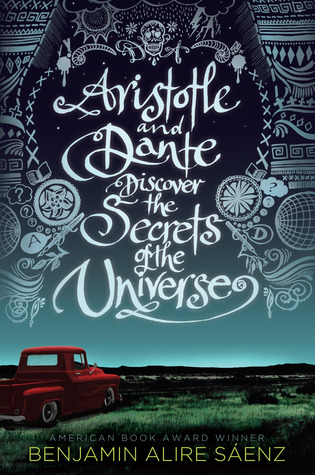
Aristole and Dante Discover the Secrets of the Universe, by Benjamin Alire Saenz: and make this Pocho starry-eyed along the way

Aristotle and Dante Discover the Secrets of the Universe
Benjamin Alire Saenz
New York: Simon and Schuster, 2012.
ISBN:  978144240892

Aristotle, or Ari, as he prefers to be called, is fifteen, introverted, bored, and a bit of a loner.  While teaching himself to swim at the local pool, he meets Dante.  Dante is fifteen, extroverted, artistic, has a way with words, and can swim.  Dante offers to teach Ari to swim, and the boys develop a quietly powerful friendship.  Ari’s boundaries begin to be chipped away by Dante’s curiosity, and he begins to ask himself questions about his family, himself, and his world.  When Dante’s family needs to move away for the year for his father’s job, their friendship is tested by distance and, over the course of the year, by the admission of one of the two that he is not attracted to girls.   This story is beautiful, simple, and yet complex on many levels.  It is a strong recommendation for teens 14 and up, and adults.  Every library with an ounce of self-respect should have this in their catalog!

This book is nearly impossible to summarize.  That’s not because it’s super complex, or because I don’t want to spoil it, but the exact opposite (well, except the spoiling part – I hate Uncle Spoiler!).  The story itself is relatively simple as a realistic look into the worlds of two boys and their families, the nuances and secrets that all families have, their related personal growth and search for identity, and the increasing acceptance of self that is true of many coming of age stories.  But this is not a simple coming of age story.

Wednesday, November 6, 2013

Reality Boy, by A.S. King: Reality Bites


Reality Boy

A.S. King
New York: Little Brown, 2013.
ISBN: 978-0-316-22270-9
ARC copy reviewed

Do you ever what happens to the kids whose lives are televised for the world to see in the booming age of exploitative reality television?  A.S. King certainly does.  In her latest novel, protagonist Gerald Faust can tell you from personal experience that it is not a burden you wish on anyone, especially a child.  Now a teenager, he is still known and mocked for his fecal exploits on the reality TV show SuperNanny, and the subsequent and unwanted Internet replay stardom.  Not surprisingly, he has some serious anger management issues.  He boxes, has regular sessions with a therapist, attends special ed classes, and holds a job as he strives to get through his day, despite the bullying that makes him want to explode, and his rather dysfunctional family.  He is on the brink, either of collapse or major change.  This title is an engagingly and thoughtfully crafted alternative coming of age title.  It is strongly recommended to high school aged teens and adults.  

Monday, April 29, 2013

A Corner of White, by Jaclyn Moriarty: Oh, Cello there, you manic pixie dreambook!


A Corner of White
Jaclyn Moriarty
New York: Arthur A. Levine, 2013.
ISBN: 978-0-54539736-0
ARC copy via NetGalley


Realism and magical realism entwine to make beautiful music together in this enchanting first book in a planned trilogy by Jaclyn Moriarty.  In two cities populated by two quirky, endearing, supporting casts, two hugely likeable teenage protagonists grapple with missing people, life and familial changes, challenges, and adapting to them.   Serial runaway Madeleine has finally made it permanent by bringing her mother along.  She is struggling to adapt to her new life, and begins to worry about her mother’s health as she attempts to complete a home-school history assignment to channel Isaac Newton.  Town golden-boy Elliot, however, is eager to find his missing father, who disappeared in the same storm that killed his uncle.  He reluctantly agrees to delay his trip to help his mother prepare to rent his fathers shop to the strange newcomers to town.  Things begin to come together when each teen finds a mysterious letter, tucked away in an unlikely place, and begin the most unusual pen pal exchange ever to occur between the Land of Cello, and the world.  Playful, yet deeply thoughtful and well written, this is a unique and delightful novel.  Parts epistolary, narrative, fantasy, realism, it abandons genre and reader expectations and is wholly, whimsically, realistically, magically fantastic.  It is strongly recommended for both teens (grade 8 and up, but younger readers who can hang with complex plots with like this too) and adults.  

If you couldn’t tell, I maybe kind of really enjoyed this book.  I suspected I would; I have found Jaclyn Moriarty’s books to consistently be majorly delightful, and was pumped to have at A Corner of White.  You guys – she did not let me down.  In fact, I was so engrossed that I didn’t realize until about 60 pages that I had no idea how two such seemingly disparate stories would, or could even come together – and then was like I SEE WHAT YOU DID THERE when she did, in a way that was very true to her previous books.  I won’t say any more to spoil it though!  I will say that there HAS to be something in the Australian water – yet again I’ve fallen for the charm from down under!

I took copious post-it notes, while reading this on a bus to and from Newark, NJ, to hang out with ¾ of the super fabulous Brown family (hi guys!).  Being that my copy came from NetGalley, this was a slightly weird process, whereby I stuck them all to the back of my Nook, and now can’t read them, because who writes legibly on a bus?  I’m also pretty sure a bunch of them fell out…because I swore there were more than four.  But I digress.

Friday, May 27, 2011

No and Me, by Delphine de Vigan: Sacre bleu my mind with a translation done right!

No and MeNo and Me
by Delphine de Vigan  (Translated by George Miller)
New York: Bloomsbury, 2010

 ISBN: 978-1-59990-479-5

 Precocious and bright Parisian thirteen-year old Lou is both intelligent enough to have skipped several grades and to realize that she is less mature than her older classmates.   Scientifically minded but shy, Lou panics when forced to publicly announce her plans for a class presentation and announces she will be interviewing a homeless woman, though she knows no homeless people.   Lou takes to the task like one of her scientific product tests, and soon has found her subject: No, a homeless young woman she meets at the train station.   No, and the interviews with her, open Lou's eyes to the heartbreaking world of the homeless that is hidden in plain sight as she comes to realize, visible only to those who choose to see it.   Having suffered a family loss, Lou's mother has been recovering from a deep depression for years, leaving just her often busy father to care for her, thus opening the door for naive Lou to throw herself into what becomes a near scientific obsession with trying to save No, going so far as to convince her parents to let No move in and get back on her feet.  As one may suspect, things don't go exactly as planned, but while there are some hard lessons learned and Lou's childish naivete is shattered, this gorgeously translated, thoughtful, and carefully constructed novel does not fall into cliches and is a testament in many ways to the qualities of hope, perseverance, and unflinching love.  It is strongly recommended for all collections, teens mature enough to understand the complexity of the issues (grades 8-12) and would be an easy sell to many adults as well.  

Remember when I went on and on about how I thought the translation of The Invisible was...okay?  Well, THIS, my friends, is a translation done right.  The language is gorgeous and moving, almost melodic.  As a former language major, I can assure and reassure you that translating words is easy - translating the feelings and emotions behind them and maintaining the original beauty is a tremendously difficult thing to do.   Behold:
 Sometimes I leave her there, in front of an empty beer glass.  I get up, sit down again, hang around, try to find something to comfort her.  I can't find the words.  I don't manage to go.  She looks down and says nothing.
And our silence is filled with all the world's impotence.  Our silence is like the return to the origin of things, their true state. (51)
I mean, DAY-YUM, shiver me timbers.  That's some weighty prose for a book marketed to kids.  That's not even the best of it; I'm just too lazy to search for more.  Mad snaps for George Miller, who has made me want to learn French just to read this in the original too!  But regardless, this book is wonderful because it takes what could turn into a totally cliched everyone's-feeling-sadface story (homelessness, depression, awkward teenage years, feelings of abandonment all around) and doesn't do exactly what you would expect with it in all cases.  Yes, it is not a "we saved a homeless girl, high fives all around" happy ending.  Unless you are possibly a teenager reading this, you realize there is more going on with why No is homeless than just that she has no home and nobody to care for her.  It's easy enough to spot how Lou is both scientifically obsessed with finding a cure for homelessness, starting with Lou, and how No is also filling an emotional void in Lou's life, left when her infant sister passed away and her mother disappeared into a very serious and long lasting depression.  Part of growing up, though, is realizing that not everyone wants to or can be rescued; as de Vigan says "things are always more complicated than they seem," (72).  Despite the potential to tie this story up with a shiny ribbon (and Lordy, Lordy, do I like things tied up), I found the "there is no one solution to this problem" ending quite satisfying, even refreshing because it recognizes that there is no one simple solution to a huge societal problem, but that it is one that we cannot ignore.  Perhaps my favorite passage in the whole book sums this one up, one which both foreshadows what Lou already may know in her heart and yet doesn't realize due to her youth:
Dogs can get taken in, but the homeless can't.  I thought to myself that if everyone took in a homeless person, if everyone decided to look after just one person,  to help him and be with him, perhaps there'd be fewer of them in the streets.  My father told me that wouldn't work.  Things are always more complicated than they seem.  Things are what they are, and there are lots of things you can't do anything about.  You probably have to accept that if you want to become an adult.  We can send supersonic planes and rockets into space, and identify a criminal from a hair or a tiny flake of skin, and grow a tomato we can keep in the fridge for three weeks without getting a wrinkle, and store millions of pieces of information on a tiny chip.  Yet we're capable of letting people die in the street. (71-72)
Double DAY-YUM.  Doesn't the optimism and teenage idealism just shank you right in the heart?  Don't you want the solution to be so simple?  And when you put it in those terms, it really is bananas that there is no solution, until, as Lou points out (and learns), you realize as an adult (or really with-it teen) that there are more factors in play than just the obvious problem.  This book takes what is at best a complex, philosophical, societal, moral, ethical, insert a few more descriptive words in here, problem and presents a story that is moving, yet not preachy, and more importantly, frames it in a way that is accessible without dumbing it down or pretending that there is an easy solution.  Well played, Delphine de Vigan! I will certainly be adding this to my collection and encourage all libraries, especially those serving privileged kids, to do so as well.

Wednesday, May 19, 2010

I need a hair cut

I have recently begun a project at work to film our book talks to help kids choose which books (from off of our 71 page summer reading list) to read for summer reading. It is a slightly more personalized way to get an idea or feeling about a book. Great idea, right? I KNOW. That's why I thought of it!

Except one small problem. I am now on the interwebs. And high def is unforgiving. And now I am well aware that the back of my head has hair that is doing crazy gravity-defying things. Today's book talk(s) for Dairy Queen, by Catherine Gilbert Murdock, made this sad fact abundantly clear. Also, now you can make fun of my acting skillz. Or lack thereof.

Moral of the story: I need a hair cut (or them all cut, right Popstar?).
Related Posts Plugin for WordPress, Blogger...